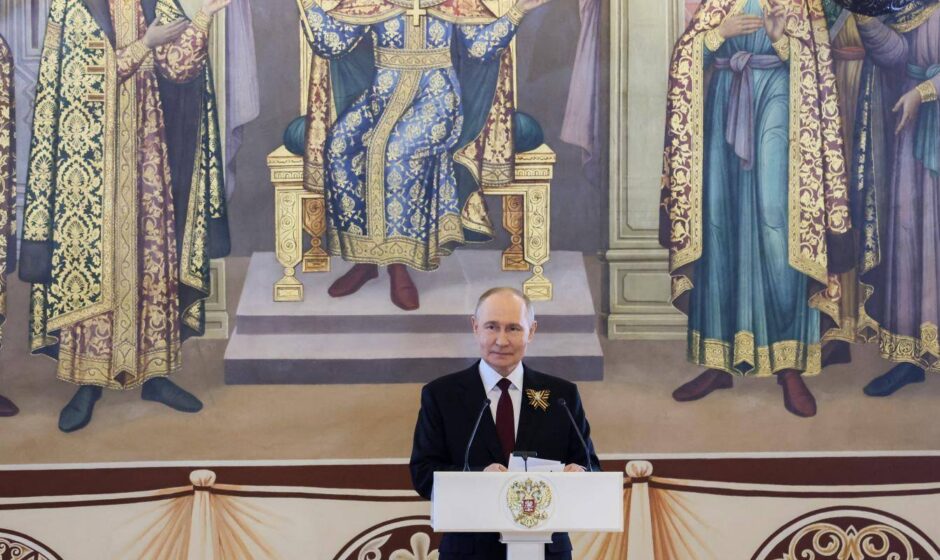

Vladimir Putin is not just a politician; he is a storyteller. In his long, often rambling speeches, the Russian president weaves historical narratives that blur fact and fiction, reshaping centuries-old events to justify modern aggression. One of his most persistent tales recasts the Rurik dynasty as the foundation of exclusively Russian history—conveniently erasing Ukraine’s identity as an independent, sovereign nation. This selective retelling is not accidental. It is a political weapon, and Europe has underestimated its power for far too long.
As Russia’s war in Ukraine drags on, one reality is becoming impossible to ignore: Europe lacks a coherent doctrine to confront Putin’s expansionist ambitions. Sanctions, statements, and fragmented military support are not a strategy. They are reactions. And reactions alone will not stop a leader who believes history itself gives him permission to redraw borders.
Putin’s History as a Political Weapon
Putin’s obsession with history is not academic—it is strategic. By portraying Ukraine as an artificial state and Kyiv as merely a cradle of Russian civilization, he seeks to delegitimize Ukraine’s sovereignty in the eyes of Russians, allies, and even wavering Europeans.
This narrative rests on distortion. The Kyivan Rus, often cited by Putin, was a medieval federation whose legacy belongs to multiple nations, including Ukraine. Yet Putin’s version collapses complexity into a single, dangerous conclusion: that Ukraine has no rightful existence outside Moscow’s influence.
When history is weaponized this way, tanks and missiles soon follow.
Europe’s Strategic Confusion
Europe’s response to Russia’s aggression has been morally strong but strategically inconsistent. Individual states have acted decisively, yet collectively the continent remains trapped between caution and conviction.
The European Union was built as a peace project, not a geopolitical power. Its institutions are excellent at regulation and trade—but ill-equipped for deterrence against a revisionist state willing to use force.
Without a unified doctrine, Europe risks appearing predictable, hesitant, and reactive—exactly the conditions Putin exploits.
Expansionism Is Not Limited to Ukraine
Ukraine is not the endgame. Putin’s broader ambition is to reassert Russian influence over the former Soviet space and weaken Western unity. Moldova, Georgia, the Baltic states, and even parts of the Balkans exist within Moscow’s strategic imagination.
Hybrid warfare—cyberattacks, disinformation, energy blackmail, and political interference—has already become a permanent feature of Russia’s engagement with Europe. These tools allow Moscow to destabilize democracies without firing a shot.
Europe cannot afford to treat each crisis as isolated. They are chapters of the same story.
Why Sanctions Alone Are Not Enough
Economic sanctions have damaged Russia’s economy, but they have not altered the Kremlin’s core calculations. Authoritarian systems can absorb economic pain, especially when nationalist narratives frame hardship as sacrifice.
Moreover, Europe’s early hesitation on energy dependence revealed a critical vulnerability. Years of reliance on Russian gas created leverage that Putin used skillfully.
A doctrine must go beyond punishment. It must reshape incentives, reduce dependencies, and signal long-term resolve.
What a European Doctrine Should Look Like
Europe needs a clear, credible doctrine of deterrence and resilience, built on five key pillars:
- Permanent Military Readiness
Europe must accept that peace requires preparedness. This means sustained defense spending, joint military planning, and rapid-response capabilities independent of political cycles. - Unambiguous Red Lines
Putin thrives on ambiguity. A European doctrine must define consequences clearly—not just for invasions, but for cyber warfare, election interference, and attacks on infrastructure. - Strategic Support for Border States
Countries on Europe’s eastern flank must never feel expendable. Long-term security guarantees—not ad hoc aid—are essential. - Energy and Economic Sovereignty
Strategic autonomy is not protectionism; it is survival. Europe must ensure no adversary can hold its economy hostage again. - Narrative Power
Europe must challenge Putin’s historical distortions with confidence. Silence allows falsehoods to metastasize.
The Cost of Hesitation
Every delay emboldens aggression. Putin’s calculations are shaped by perceived weakness, not goodwill. When Europe hesitates, he advances—testing limits, probing unity, and exploiting division.
The lesson of the past decade is brutal but clear: appeasement does not prevent conflict; it postpones it at a higher cost.
Ukraine is paying that cost today with lives, cities, and futures.
A Battle of Worldviews
This is not merely a territorial dispute. It is a confrontation between two worldviews: one that sees sovereignty as conditional and power as inherited, and another that believes borders are inviolable and legitimacy comes from the people.
If Europe fails to defend the latter, it undermines its own foundations.
Putin’s expansionism thrives in gray zones—where values are negotiable and principles are flexible. A doctrine replaces gray zones with clarity.
Europe’s Moment of Choice
History will judge Europe not by its rhetoric, but by its resolve. The continent stands at a crossroads similar to those faced in the 20th century, when delayed action allowed authoritarian ambitions to spiral.
A European doctrine is not about confrontation for its own sake. It is about prevention—making aggression futile before it begins.
The question is no longer whether Europe can afford such a doctrine. It is whether Europe can afford not to have one.
Conclusion
Vladimir Putin’s stories are powerful because they offer certainty in a complex world. Europe’s response must be equally clear—not rooted in myth, but in strategy.
Ukraine has exposed the consequences of complacency. If Europe wants peace, stability, and credibility, it must move beyond fragmented responses and adopt a doctrine that matches the scale of the challenge.
History is being written in real time. Europe still has the chance to shape the ending—but only if it chooses clarity over caution, unity over hesitation, and strategy over reaction.